

Rolling coverage of the latest economic and financial news
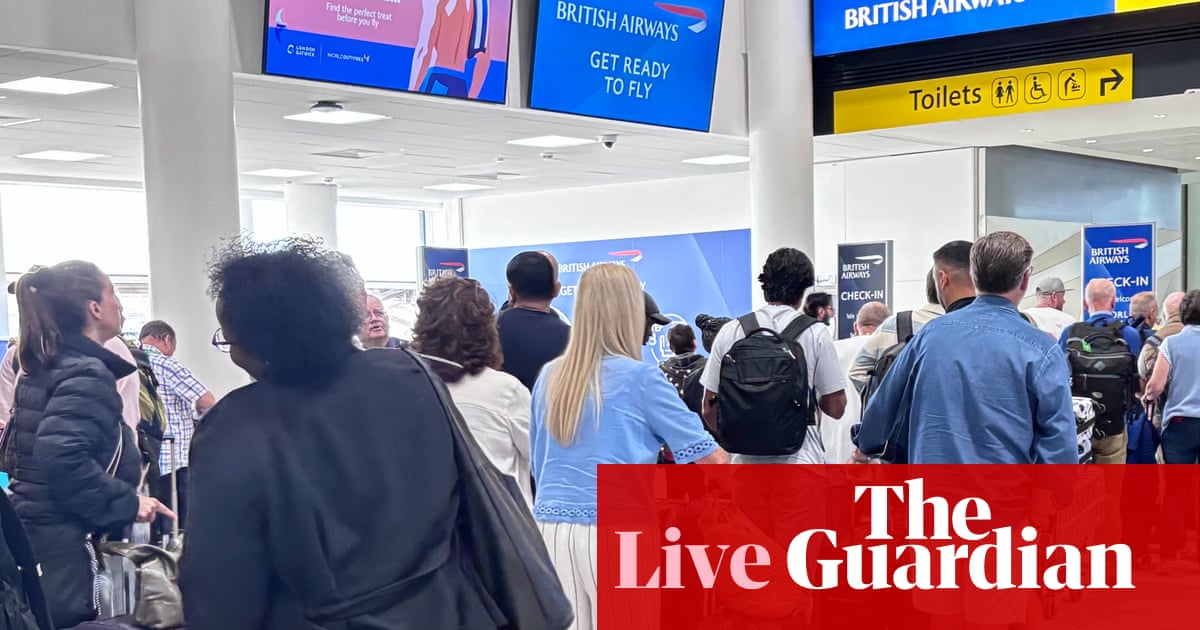
Newsflash: British air traffic control operator Nats has reveale that the outage which affected hundreds of thousands of passengers last week was due to a software defect.

Martin Rolfe, Nats chief executive officer, says:
“This was a software issue in a specific part of our flight data system, that we have traced to a small subsection of coding.
The issue has been identified and mitigation is in place while a permanent fix is safety tested and deployed.”
The Financial Times reported last week that four people briefed on the incident claimed that the shutdown was caused by a flight plan submitted by a UK military aircraft.
NATS, though, is blaming “a software defect” in a small part of the National Airspace System (NAS), which is used to manage of UK airspace.
Hundreds of thousands of passengers were caught up in the disruption which began on Tuesday 8 September.
The software in question allocates codes to individual aircraft when manual requests are made; these are usually allocated automatically. These codes are used to identify flights on radar when they are airborne.
This glitch led to restrictions being put in place to limit air traffic to maintain safety. Although the software issue only affected flights in the London Area Control centre – higher level flights operating mainly above 24,500ft – the restrictions had to be placed across the UK so that the NAS could be restarted and flight data reloaded, it says.
A software defect in part of the UK’s air traffic control system corrupted flight data “in the space of a millisecond”, leading to a six-hour outage and mass airline cancellations and delays across the UK last week, National Air Traffic Services has said.
But ministers said the Nats report into the incident still left questions unanswered, saying they needed “to urgently understand why this issue was not discovered and fixed before it caused chaos”.
According to the report, the error first occurred at 10am and was notified to engineers who investigated – but the system appeared to be working again, until 12.30pm when a repeat occurred and a major incident was declared.
The transport secretary, Heidi Alexander, said the industry regulator the Civil Aviation Authority (CAA) would now “check their findings” and investigate Nats’ plans.
Volkswagen has cut its financial guidance for this year, due to issues at Porsche, provisions for job cuts and a weak Chinese market.
The London stock market has recorded its biggest one-day drop since early July.
Japan’s central bank has increased interest rates to a fresh 31-year high as it attempts to combat global inflation linked to the war in Iran.
The Bank of Japan (BoJ) voted to raise its target interest rate from 1% to 1.25%, the highest level since 1995.
The move meant the BoJ joined the US Federal Reserve and the European Central Bank in tightening monetary policy this month, as central banks attempt to curb the impact of rising prices, linked to the conflict in the Middle East.
Retail sales across Great Britain unexpectedly rose last month, the latest economic indicator to defy gloomy forecasts as the chancellor, John Healey, prepares to present next month’s budget.
Newsflash: German carmaker Volkswagen has slashed its outlook, and warned that it faces a €10bn hit due to challenges at its Porsche division and in China, and the cost of job cuts.
Volkswagen has cut its forecast for Operating Return on Sales to ‘up to 1%’, down from a previous forecast 4.0 to 5.5%.
It is taking a €6bn non-cash impairment against goodwill allocated to Porsche.
Additional restructuring expenses from the expansion of early retirement schemes, the planned sale of its Osnabrück site, and “the development in the Chinese automotive market” will knock another €2bn off profits.
The news came before the Frankfurt market closed, so there was time for Volkswagen’s shares to fall by 5.5%.
Britain’s blue-chip share index has posted its biggest one-day drop in over two months.
The FTSE 100 share index has closed for the day, down 157 points or 1.45% at 10,659 points, its biggest one-day drop since 8 July.
Airtel Africa (-11.3%) was the top faller, following reports that its Airtel Money division is considering downsizing its London IPO.
Retailers and mining stocks were also in the fallers.
Stocks fell alongside government bonds today, as the yield on UK and US debt rose (see earlier post).
Fears of higher interest rates abounded today, after the Bank of Japan became the latest central bank to raise interest rates.
Back in the financial markets, UK and US government debt is continuing to sell off.
This has pushed the yield, or interest rate, on US two-year Treasury yields up to 4.7475%, the highest since July 2024. That’s a rise of 5.5 basis points (0.055 of a percentage point).
UK two-year gilts are selling off faster – pushing up their yield by 13 basis points (a rather chunky move), to 4.85%.
Traders may be disappointed that the early fall in the oil price has now all-but reversed, following reports that Saudi Aramco told at least two oil refining customers in Europe that they will be allocated no crude next month.
Premium sportswear brand On has signed a sponsorship deal with Kylian Mbappé - thereby ending the French sensation’s long-standing partnership with Nike - in a bid to break into the football market, my colleague Amee Joshi writes.
The Swiss company, founded in 2010 by ex-McKinsey consultants David Allemann and Caspar Coppetti, alongside world champion triathlete Olivier Bernhard, became known for its ‘Cloutec’ technology which Bernhard described as imitating the feeling of “running on clouds”.
Just over a decade on, in 2021, the trio floated the company on the New York Stock Exchange at a valuation of $8bn, raising almost $750m. It has since been recognised as one of the fastest growing brands in the industry, with their first-quarter sales growing to 14.5% this year, surpassing analysts forecasts.
Losing Mbappé, the star footballer many believe is poised to win this year’s Ballon D’or, only adds to Nike’s growing list of woes. Over the last five years, the sportswear giant’s shares have fallen by 75%, cast down by decreasing revenues in the lucrative Chinese market. Their persistent struggles culminated in last week’s announcement that it will crash out of the S&P 100.
Part of Nike’s decline has been attributed to their loss of focus on innovation, allowing smaller rivals, like On and Hoka, to attract top athletes and celebrities (like world champion marathon runner Hellen Obiri and actress Zendaya), and grow their global market share.
The “High Level Timeline” into the software glitch on 8 September shows there was a gap of almost two and a half hours before the initial problem, and the start of a major incident.
Initially, air traffic controllers and system engineers receive a system error notification at 10.02am that morning, related to the squawk code request explained in our earlier post.
That notification swiftly vanished, though, suggesting the system had recovered.
Between 10.06am and 12.32pm, health checks were carried out on infrastructure with no evidence found of any hardware fault.
But then at 12.32pm, the link between the London Area Control (LAC) system and the NAS was automatically dropped and the LAC system enters “a period of link instability”.
At 12.45pm, flight restrictions were imposed, and departures from UK airfields were temporarily stopped, so that air traffic controllers could operate safely under fallback arrangements.
Further restrictions were imposed through the day, before all airspace restrictions were lifted at 7.30pm.
Today’s report from Nats is only the provisional probe into this month’s disruption – the full inquiry will take longer.
Our full investigation into the circumstances is under way and our major incident report will be completed within 60 days. At this early stage, however, I can confirm that this incident is not related to either the 2023 NATS FPRSA system failure or the radar issue in July last year.
I can also confirm that it was a software issue and not caused by any incorrect actions by either military or civil operators.
The software error which brought UK airspace to a standstill was due to a problem handling squawk codes - an identification code transmitted (squawked) by the aircraft during flight.
Nats’s report explains that the incident was triggered by a valid manual request for a squawk code.
While this request was being processed, the National Airspace System received a message for a higher priority activity to be undertaken which resulted in the squawk code allocation being paused while the system processed the higher priority message.
So far, so normal. But, when the processing of the squawk allocation request resumed, the software defect meant it did not resume correctly and the resulting output was corrupted.
Nats says there was a very narrow window for things to go wrong in:
The defect existed in a specific subsection of code within a software module, with an exposure window estimated as approximately one millisecond.
For the fault to occur, a higher-priority request had to arrive during that exact millisecond while the original request was part-way through updating a value.
Had the higher-priority request arrived even one millisecond earlier or later, the update would have completed normally.
The full scale of disruption will take time to confirm; but at this stage more than two thousand flights were delayed, cancelled or diverted, Nats says.
The air traffic controller adds that it handled some 1,800 fewer flights than forecast over the course of the day but we appreciate that does not reflect the full scale of the disruption experienced.
There is no evidence at this stage to suggest that the incident was caused by a malicious actor or cyber related activity, Nats insists in its report.
Originally reported by Guardian Business.