

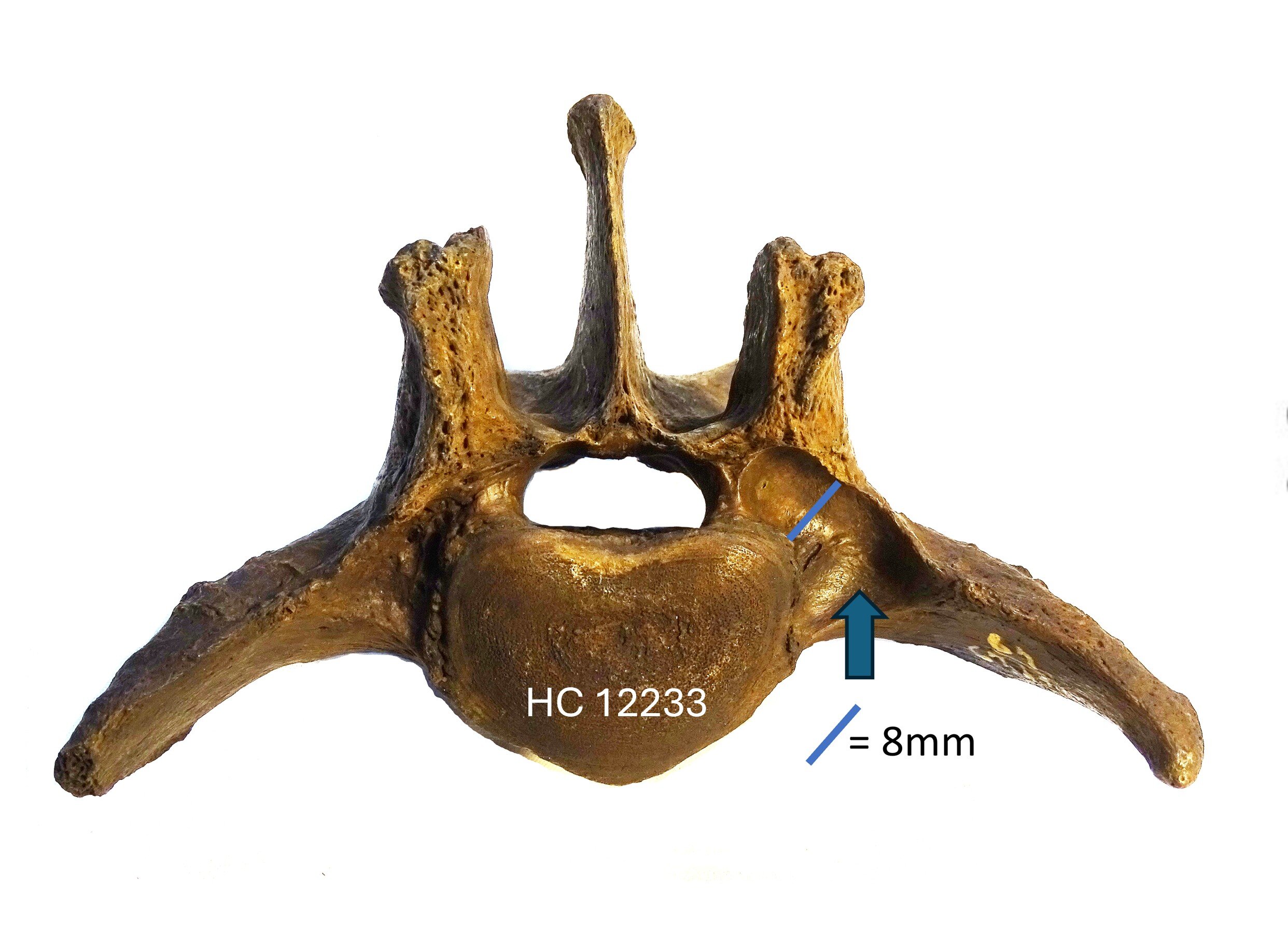
The fossilized spines of saber-toothed cats in the La Brea Tar Pits reveal evidence of an unexpectedly high prevalence of rare spinal nerve tumors, suggesting that the species became inbred just before extinction. These tumors, which cause significant pain and reduced limb function, could have made the cats particularly vulnerable to the lure of prey animals stuck in the tar pits.
"A trapped prey animal is very attractive for a predator in pain," said Dr. Hugo Schmökel of the Evidensia Academy Sweden and the University of Zürich, lead author of the article in Frontiers in Veterinary Science. "A wounded or sick predator must rely on carcasses to survive, so they'll take bigger risks to get to them."

At the La Brea Tar Pits in California, crude oil seeps up through cracks in the ground in the form of ponds of sticky black tar that can trap animals that walk into them. The distress calls of trapped prey attract predators, which then become trapped themselves. During the Pleistocene, this included saber-toothed cats—Smilodon fatalis.
"Smilodon was an ambush hunter, hiding in the lush vegetation of the late Californian Pleistocene, jumping on prey and wrestling it down until a fatal stab ended the hunt," Schmökel said. "But scavenging certainly also happened."
Well-preserved specimens of Smilodon held by the La Brea Tar Pits Museum allow scientists to look for evidence that could help us understand the species' extinction. Schmökel and his colleagues investigated Smilodon's spines. They identified 3,722 vertebrae, representing at least 849 adults, in the museum's collection and examined them for pathological changes.
They found numerous cases of developmental abnormalities: 32 vertebrae with incompletely developed arches, 48 fused "block" vertebrae and 226 "transitional" vertebrae, where vertebrae form incorrectly—for example, cervical vertebrae that form like thoracic vertebrae, with a rib.
Even more strikingly, the scientists found widened foramina, holes that allow nerves to travel through the spine, in three vertebrae. Widened foramina with a smooth remodeled surface are a very strong indication that the individual was affected by a spinal nerve tumor: The tumor grows and exerts pressure on the bone over time, increasing the size of the hole.
"Dogs that are brought to my clinic with a spinal nerve tumor mainly have signs of pain, and many human patients with a spinal nerve tumor complain of pain," Schmökel said. "This was probably also the case in Smilodon. In advanced cases without treatment, the nerve and the affected limb eventually lose function, making hunting very difficult."
Spinal nerve tumors are extremely rare in both humans and modern-day animals. Human cases are caused by specific genetic mutations, either spontaneous or inherited. Doctors see approximately 0.22–0.38 cases for every 100,000 humans.
By contrast, the presence of three cases—the affected vertebrae came from three different pits, so must have belonged to different animals—means that the estimated prevalence rate at the La Brea Tar Pits is a staggering 353 cases for every 100,000 Smilodons.
We can't be sure why Smilodon was so severely affected by spinal nerve tumors. But the high prevalence of developmental abnormalities leads the team to suspect that the species had become inbred, although this can't be proven without genetic analysis.
As their numbers began to fall, so that fewer potential mates were available, harmful genetic variants could have become concentrated in the population, increasing the likelihood that each litter of kittens inherited health problems. The same spinal malformations have been documented in modern-day inbred gray wolf populations.
The scientists point out that the tumors themselves could have increased the chances that the cats ended up in the tar pits: Pain and difficulty hunting might have led them to take greater risks than healthy animals. But for Schmökel, the evidence of inbreeding is a wake-up call regarding our treatment of modern megafauna.
"Reduced fitness and smaller litters don't help a population under stress," Schmökel said. "But inbreeding is not the cause of the crash of populations, it is a medical consequence. Loss of habitat, pollution, hunting or poaching, and in some areas today climate change, are the cause of the fall in numbers of wild cats. We can assume that the same happened to Smilodon at the end of the Pleistocene.
"We must take care of living wild animals. We humans reduce their living space, hunt them, pollute them. And when there are only a few left, we start, maybe, to act. But by then these animals are probably affected by inbreeding, and saving them is more difficult."
Foraminal widening indicating a spinal nerve tumor in the saber-tooth cat Smilodon fatalis from Rancho La Brea, Frontiers in Veterinary Science (2026). DOI: 10.3389/fvets.2026.1857385
BSc Life Sciences & Ecology. Microbiology lab background with pharmaceutical news experience in oil, gas, and renewable industries. Full profile →
Bachelor's in mathematical biology, Master's in creative writing. Well-traveled with unique perspectives on science and language. Full profile →
Originally reported by Phys.org.