

Traditionally, public health programs have relied on chemicals for mosquito management, which may be why combating mosquitoes is becoming more difficult. Over time, insecticides trigger biochemical and genetic variations that confer a survival advantage on certain mosquito populations.
In a new Frontiers in Tropical Diseases study, researchers in India examined the mechanisms of resistance to α-cypermethrin, a common insecticide used for vector control worldwide.

"We show that an Indian Ae. aegypti mosquito population demonstrated a 97.91% mortality rate when exposed to the recommended diagnostic dose of α-cypermethrin. This is an early sign these mosquitoes could be developing resistance to this insecticide," said first author Dr. Rohit Lakhwani, a researcher at the University of Delhi.
"Understanding the biological mechanisms that allow mosquitoes to survive this insecticide while resistance is still in its early stages is advantageous," added senior author Dr. Sarita Kumar, a professor in the Department of Zoology at the University of Delhi.
Insects possess detoxification enzymes, proteins they produce naturally to defend themselves against toxic substances, often within hours of exposure.
"When an insecticide enters a mosquito's body, it activates a cellular alarm system. This triggers a cascade of responses within the insect's cells and ramps up production of defensive proteins," explained Kumar.
Detoxification enzymes bind to insecticide molecules, break molecular bonds and leave behind less harmful compounds that can be excreted easily.
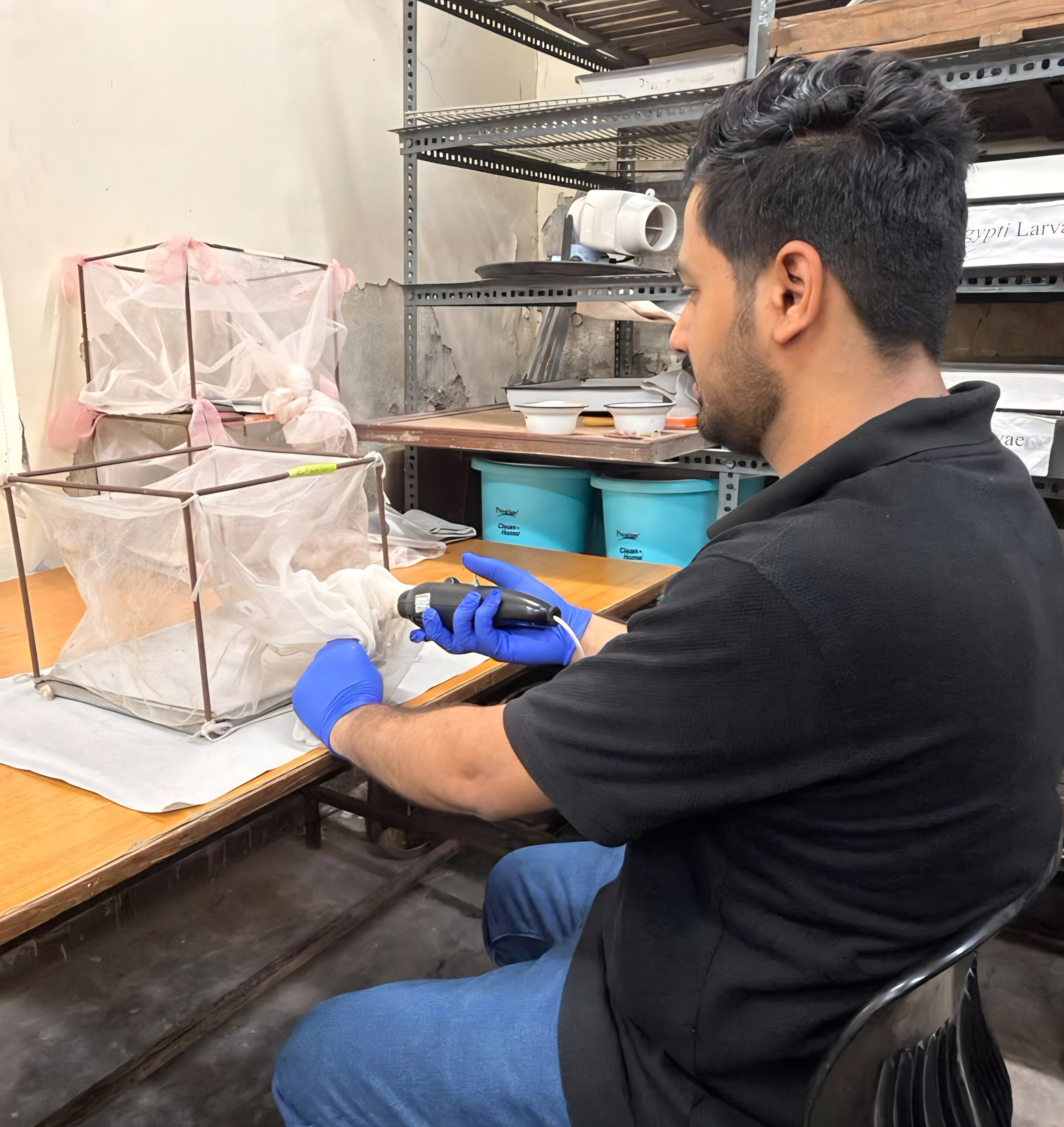
The team selected five detoxification enzymes that had previously been identified as primary detoxification mechanisms. They used WHO bottle bioassays, which expose live mosquitoes to diagnostic concentrations of insecticide; molecular docking, a computer-based analysis that predicts the binding affinities of insecticides with detoxification enzymes; and biochemical analysis to uncover different detoxification enzyme levels in mosquito populations.
They found that β-esterase—an enzyme that specializes in breaking down specific compounds prevalent in insecticides like α-cypermethrin—was most reactive in response to the insecticide. Its activity increased more than 21-fold following exposure, and it bound very strongly to the insecticide's molecules. This suggests that the enzyme is the primary mechanism through which mosquitoes defend themselves against α-cypermethrin.
The other enzymes included in the study were also significantly involved in detoxification. CYP450, an all-rounder that can respond to a multitude of foreign chemicals, and GST, which attaches protective molecules to toxic compounds, showed the second- and third-strongest reactivity.
"This means mosquitoes can dramatically increase production of a particularly effective enzyme when exposed to a threat. Other enzymes show more general activity against many different toxins but may not be optimally suited to this particular insecticide," said Kumar.
The limited efficiency with which detoxification enzymes attack insecticide molecules explains why some enzymes showed a weaker reaction.
Despite early signs of resistance to α-cypermethrin, these mosquitoes have not developed lasting resistance. Instead, this is a warning sign, the team said. This is especially true because mosquitoes can develop cross-resistance to insecticides that work similarly.
"Because resistance develops at different speeds, it is not possible to predict when it will become so widespread that α-cypermethrin might not work anymore," said Kumar. "Resistance at the biochemical level can also reverse if that particular insecticide is no longer used."
Resistance can differ drastically between mosquito populations, depending on how long insecticides have been used in an area, environmental conditions and local vector-control practices. As a result, mosquitoes in some countries may already be more resistant to α-cypermethrin than mosquitoes in India.
There are different ways to overcome detoxification enzymes, including inhibitors that block defense systems. Insecticide rotation can also limit resistance by preventing it from developing in the first place. The elimination of mosquito breeding sites and biological control can help preserve the effectiveness of existing insecticides and improve long-term control.
The team pointed out that its results are specific to a lab-bred population of Ae. aegypti at a specific point in time and that resistance levels may differ in other populations, regions or under natural conditions. Nevertheless, the study consistently identified β-esterase as the primary enzyme involved in α-cypermethrin detoxification.
"Our study is valuable because it goes beyond showing that resistance exists; it helps explain how it develops at the molecular level," concluded Kumar. "It is critical that this resistance is not yet widespread. It provides an opportunity for public health authorities to implement resistance management strategies before the insecticide becomes completely ineffective."
Molecular docking analysis and biochemical characterization of metabolic detoxification enzymes in adults of Aedes aegypti L. (Diptera: Culicidae) exposed to α-Cypermethrin, Frontiers in Tropical Diseases (2026). DOI: 10.3389/fitd.2026.1882408
BSc Life Sciences & Ecology. Microbiology lab background with pharmaceutical news experience in oil, gas, and renewable industries. Full profile →
Bachelor's in mathematical biology, Master's in creative writing. Well-traveled with unique perspectives on science and language. Full profile →
Originally reported by Phys.org.